
I check our Google ranking now and then. Not often. Last time I looked, we were no longer first for "fractional CFO Thailand", a position we had held for most of a decade. Sitting above us were sites I had never heard of, thin on substance, and as far as I can tell largely AI generated.
I like being on a podium. That has been true in judo for a long time, and it turns out it is just as true in business.
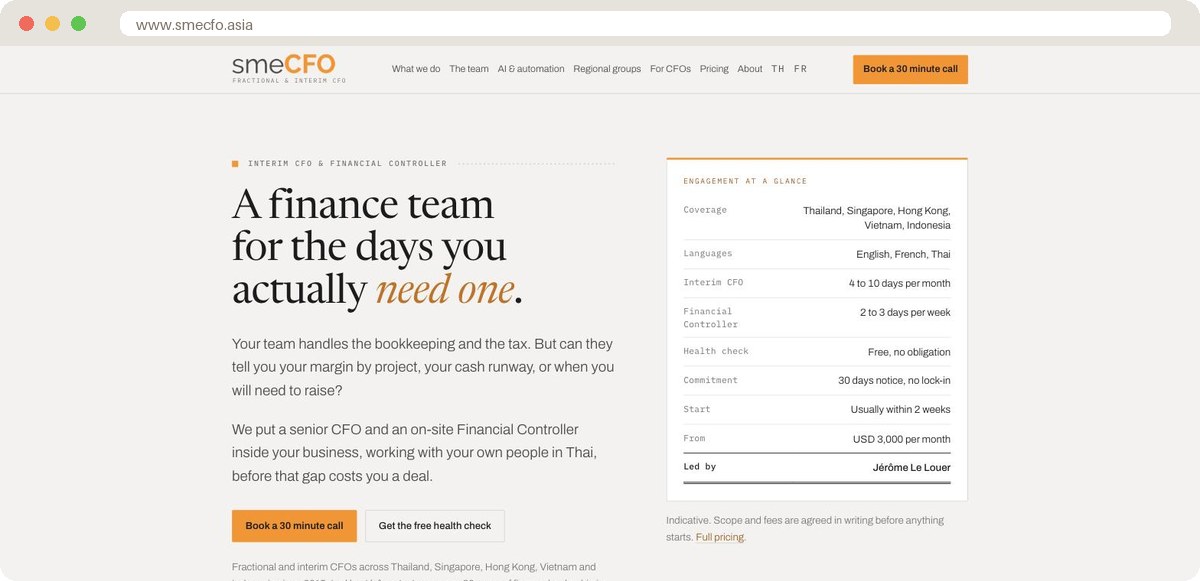
So I spent a Sunday afternoon rebuilding this website with an AI assistant, working from content we already had. I do not write code. By the evening it was live, and we are back at number one.
The site it replaced was more than ten years old. A WordPress build from around 2015, put together once and barely touched since.
The website is not the interesting part. The interesting part is that the same method is now doing real work inside client finance functions, and the thing that made it work here is the same thing that decides whether it works there.
We had first place, and then we did not
For most of the last decade this site ranked first or second for "fractional CFO Thailand" and the phrases around it. That was not clever marketing. There are not many people doing genuine fractional CFO work in this market, we have been at it since 2015, and the site had a long head start.
Then template sites started appearing above us. Quick to assemble, thin on substance, but technically newer than a decade-old WordPress install. A search engine reads the plumbing before it reads the expertise. We slipped to fifth or sixth.
Sixth place sounds better than it is. The first result takes the large majority of the clicks. By position six you are collecting what is left over.
There is an irony in that which I am happy to sit with. We were pushed down the page by AI generated websites, and the position came back using AI. The tool was never the difference. What went into ours was ten years of doing the actual work.
The part that is worth admitting
The content was never the problem. Ten years of writing about finance in Asia was still there and still good. The problem was everything around the words: page builder markup, pages that loaded slowly, a structure that did not tell a search engine what the practice actually does, and technical decisions made for a version of search that stopped existing years ago.
And I knew all of it. I had known for years. What I did not have was any way to act on it. I do not write code. Every honest route to a rebuild meant an agency, a budget and a quarter of waiting, for a job I could specify precisely but not execute myself. So it stayed on the list, year after year, while the asset quietly aged.
That gap, between knowing exactly what to fix and being able to fix it, is the thing AI has actually changed for a business this size. Not the writing. The execution.
It is also why most AI projects fail. They start with "we should use AI" rather than "here is the thing that has been costing us for years".
What was actually done
Four steps, in order.
One, everything we already had went in. The existing pages, the service descriptions, the client work, the pricing, the deck we use in meetings. Nothing was invented. The raw material was already written and paid for.
Two, the structure was rebuilt around how people search, not how we like to describe ourselves. This is the part that took judgment. A practice describes itself in the language of its own craft. Buyers search in the language of their own problem. The old site was organised around the first. The new one is organised around the second.
Three, the technical work was done properly. Clean pages, the page builder debt removed, structured data written so that both search engines and AI assistants can read what the practice is, what it covers and where. That last part matters more every year: a growing share of buyers now ask an assistant rather than a search box.
Four, every line was reviewed and corrected before anything was published. Several claims came back overstated. A statutory table needed a local check. Two names were spelled wrong. That review is not a formality, and it is the reason the result is publishable.
The result
The site now ranks first for that phrase. From first prompt to live site was a single Sunday afternoon. The number of lines of code written by hand was zero.
An honest caveat: search rankings move, they vary by location and by who is asking, and one phrase is not a marketing strategy. The point is not that a number went up. The point is that a problem which would previously have meant an agency, a budget and a quarter took an afternoon and no budget at all.
Why this belongs on a CFO site
Because the method transfers, and we have been putting it to work inside client finance functions all year.
Invoice processing that used to eat two days a month, now read automatically and pushed into the ledger. Standard operating procedures that lived in one person's head, written down properly in an afternoon. Month end packs that were rebuilt by hand every single cycle. Reporting that finally answers the question the owner is actually asking rather than the question the system finds easy to answer.
None of that replaces a finance team and none of it replaces judgment. It removes the part of the job nobody wanted to do, and hands back the hours for the part that matters.
What is worth automating, and what is not
Four things are consistently worth it: reading documents, matching and reconciling, composing first drafts, and answering questions about your own data.
Four things are consistently not: judgment calls, anything that can fail silently, approvals, and anything involving confidential data going somewhere it should not go. A reconciliation that quietly matches the wrong invoice is worse than no reconciliation, because it removes the person who would have noticed.
The rule that made it work
The judgment was mine. The typing was not.
That is the whole trick, and it is the part most people get backwards. The assistant did not decide what the site should say, which services matter, or how the practice is positioned. It did the part that was slow and mechanical, at a speed no person can match, and it did it from material a person had already thought through.
Which leads to the order of operations we now insist on with clients. Write the process down first. Then automate the boring half. Automating a process nobody has documented does not fix the process. It just makes the mess run faster, and adds a system that nobody can explain to an auditor.
What it is actually worth
Measured honestly, the return is days per month rather than headcount. In a finance function of three or four people, several days a month is usually sitting in manual work that has never been questioned, and the recovered time goes into the analysis nobody had time to do.
That is a smaller claim than the ones being made about AI at the moment. It is also one we can evidence.
How we approach this with clients, including where we refuse to automate, is set out on the AI and automation page. If you want a view of where the manual work actually sits in your own finance function, the free health check is the fastest way to find out.
Written by Jérôme Le Louer, Managing Partner at SmeCFO. The site described here was built in August 2026.